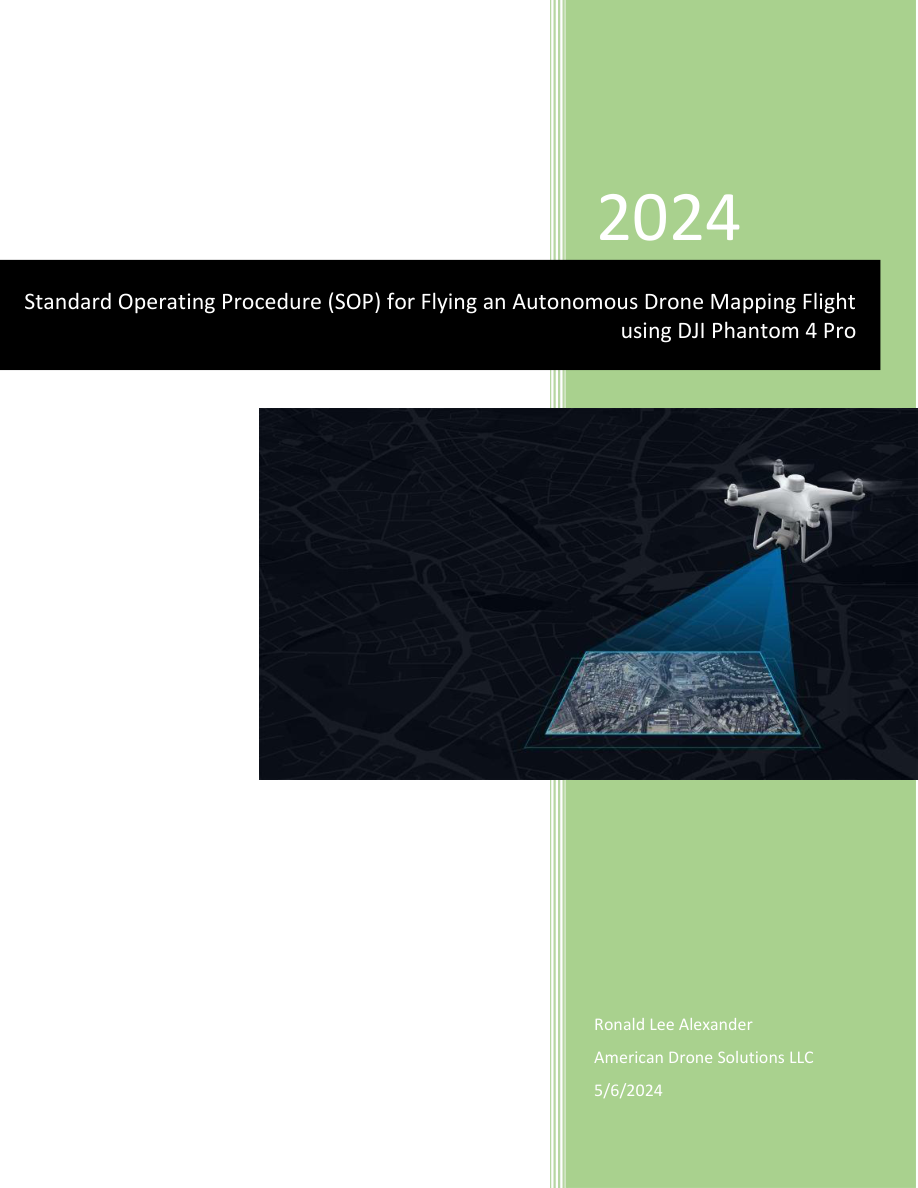
Standard Operating Procedure (SOP) for Flying an Autonomous Drone Mapping Flight using DJI Phantom 4 Pro Ronald Lee Alexander American Drone Solutions LLC 5/6/2024
Contents
Purpose: .......................................................................................................................................... 2 Scope: .............................................................................................................................................. 3 Responsibilities: .............................................................................................................................. 4 Procedure: ....................................................................................................................................... 5
1. Pre-Flight Planning .................................................................................................................. 5 2. Equipment Preparation ........................................................................................................... 6 3. Flight Execution ....................................................................................................................... 7 4. Post-Flight Procedures ............................................................................................................ 8
5. Safety Considerations ............................................................................................................. 9 Glossary: ........................................................................................................................................ 10
Purpose:
The purpose of this Standard Operating Procedure (SOP) is to establish clear guidelines and instructions for the safe and efficient operation of a DJI Phantom 4 Pro small unmanned aerial vehicle (sUAV) within the scope of this organization's activities.
Scope:
This SOP applies to all personnel authorized to operate a DJI Phantom 4 Pro within the organization. It covers all flight operations conducted by authorized personnel.
Responsibilities:
Remote Pilot (RP): Responsible for the safe and legal operation of the drone, including pre-flight inspection, flight execution, and post-flight procedures. Visual Observer (VO): Assists the RPIC by observing the drone's flight path and providing situational awareness. Safety Officer: Ensures that all safety protocols are followed during flight operations.
Signatures:
RPIC: Ronald Lee Alexander [historical credential number omitted] expires June 12,2025 VO: RL Alexander Safety Officer: Ron Alexander
Procedure:
1. Pre-Flight Planning
a. Risk Assessment:
Identify potential hazards and risks associated with the flight area, such as obstacles, weather conditions, and airspace restrictions, including NOTAMs and TFRs. Develop mitigation strategies for identified risks.
b. Site Survey:
Conduct a thorough examination of the flight area to determine suitable launch and landing zones. Identify potential hazards and obstacles within the flight envelope.
c. Weather Check:
Obtain TAF and METAR reports to assess current and forecasted weather conditions. Determine if weather conditions are suitable for safe flight, considering factors such as wind speed, visibility, and precipitation. Monitor weather conditions throughout the flight and be prepared to land if conditions deteriorate.
d. FAA Airspace Check:
Use NOTAM and TFR information to identify any airspace restrictions or authorizations required for the flight. Obtain LAANC authorization if necessary.
2. Equipment Preparation
a. Drone Inspection:
Perform a thorough preflight inspection of the Phantom 4 Pro Verify that the Phantom 4 Pro is fully charged and all batteries are securely installed. Inspect the airframe for any signs of damage or wear. Ensure that all propellers are securely attached and undamaged. Check the status of the camera and gimbal. Power on the drone and controller. Establish a stable connection between the drone and controller. Ensure that all equipment is in good working condition and meets manufacturer's
specifications. Refer to the RCM, Soft Time, Hard Time, OC, and CM component guidelines to assess equipment condition.
b. Data Management:
Format and prepare an SD card for data storage. Ensure that the drone is compatible with the DroneDeploy software.
c. Mission Planning:
Use DroneDeploy software to plan the flight mission, including flight path, altitude, and overlap settings. Program the mission into the drone's flight controller.
3. Flight Execution
a. Site Preparation:
Secure the launch and landing zones to prevent unauthorized access. Take off the drone in a clear and open area, maintaining visual line of sight (VLOS) at all times.
b. Launch Procedure:
Fly the drone within the designated airspace and altitude limits. Monitor the drone's flight path and altitude using the controller's display. Maintain a safe distance from obstacles, people, and property. Avoid flying over sensitive areas or crowds. Record flight data and imagery as necessary. Ensure VLOS until the drone has reached a safe altitude. Activate the autonomous flight mode to initiate the mapping mission.
c. Flight Monitoring:
Monitor the drone's progress through the data link or visual observation. Observe the drone's behavior and make any necessary adjustments to the mission plan.
d. Air Traffic Monitoring:
Maintain awareness of surrounding airspace and monitor air traffic using visual observation or
ADS-B.
Yield the right of way to all other aircraft.
e. Landing Procedure:
Monitor the drone's battery level and land it safely when it reaches a predetermined threshold. Switch to manual flight mode and land the drone. f. Emergency Procedures The RPIC should brief the flight crew before the start of the flight operations about emergency procedures and have a mission abort site for landing in the case of an emergency. After the aircraft has safely landed, it should be documented for maintenance purposes.
4. Post-Flight Procedures
a. Data Retrieval:
Retrieve the mission data from the SD card. Transfer the data to a computer for processing and analysis.
b. Equipment Inspection:
Conduct a post-flight inspection of the drone, including a thorough examination of the airframe, propellers, and sensors. Log any potential issues or maintenance requirements.
c. Documentation:
Document the flight details, including flight time, mission plan, and any incidents or observations. Maintain records of all maintenance and inspections performed on the drone.
5. Safety Considerations
1. Maintain VLOS until the drone reaches a safe altitude.
2. Yield the right of way to all other aircraft.
3. Fly within safe operating distance from obstacles and persons.
4. Use anti-collision lights during daylight operations.
5. Remain aware of weather conditions and fly only when it is safe.
6. Stay informed about airspace restrictions and obtain necessary authorizations.
Glossary:
sUAV: small Unmanned Aerial Vehicle sUAS: small Unmanned Aerial System VLOS: Visual line of sight RPIC: Remote Pilot in Charge VO: Visual Observer TAF: Terminal Area Forecast is the official FAA forecast of aviation activity for U.S. airports. METAR: Meteorological Aerodrome Report SOP: Standard Operating Procedures Airframe: The main body of the drone. All other components—propellers, batteries, computer, etc. —are mounted to the airframe. NOTAM: A Notice to Airmen (NOTAM), Also known as Notice to Air Mission (FAA definition), is a notice
containing information concerning the establishment, condition or change in any aeronautical facility, service, procedure or hazard, the timely knowledge of which is essential to personnel concerned with flight operations. TFR: Temporary Flight Restriction LAANC: Low Altitude Authorization and Notification Capability, a collaboration between FAA and Industry. It directly supports UAS integration into the airspace. LAANC provides: Drone pilots with access to controlled airspace at or below 400 feet.
RCM: Reliability Centered Maintenance Soft Time: A soft time interval is one that is chosen by an operator to be done at a specific interval but may be adjusted to fit their operational Aircraft Records schedule. Hard Time: Hard-time processes mandated that all components be taken out of service when they reached a specified age, expressed as the number of operating flight hours, flight cycles, calendar time, or other stress units since new or since last shop visit. OC component: On-Condition (OC) is a preventive primary maintenance process that requires a system,
component, or appliance be inspected periodically or checked against some appropriate physical standard to determine if it can continue in service. CM component: Condition monitoring (CM) is a critical component of predictive maintenance. It is the process by which one or more parameters of a machine are either periodically measured, or continuously monitored, to identify significant changes that usually are indicative of a failure in progress.